By Aishat Braimah
Since the emergence of the Islamic insurgent group Boko Haram, northeastern Nigeria has been in a state of conflict. The
region has borne witness to the most horrific acts of violence perpetrated by Boko Haram members,
and a complete disregard for humanity and human rights. As is common in conflict situations, much
of these acts of violence have targeted women and girls. June 19, 2018 being the International Day
for the Elimination of Sexual Violence in Conflict, is a crucial day to recognize and address the
humanitarian crisis arising from the prolific sexual violence inflicted on women and girls in conflict
Nigeria.
According to the United Nations (UN), conflict-related sexual violence includes (but is not limited
to): “rape, sexual slavery, forced prostitution, forced pregnancy, forced abortion, enforced sterilization,
forced marriage and any other form of sexual violence of comparable gravity perpetrated against women,
men, girls or boys that is directly or indirectly linked temporally, geographically or causally to
a conflict.” Though the northeastern region is currently in a post-conflict situation, the acts of
sexual violence committed during the periods of conflict, have seemingly continued into the post-conflict
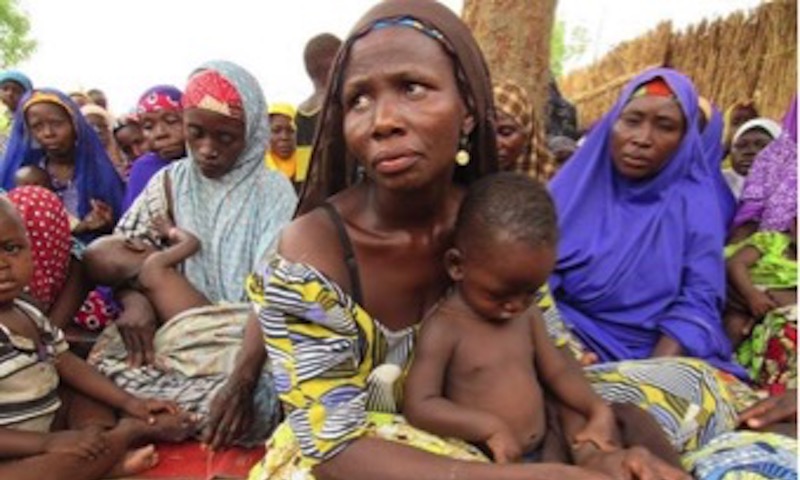
situation. Women and girls who have been internally displaced by the war against Boko Haram, now
face gender-based violence (sexual exploitation in satellite IDP camps, child prostitution, forced
marriage and rape) in the military-led satellite camps, which ironically were established to protect
them.
In January 2016, multiple UN Special Rapporteurs commissioned by the Office of the High Commissioner
for Human Rights (OHCHR), visited Maiduguri in northeast Nigeria, where they conducted several humanitarian
assessments and investigations. From their assessments and investigations, they found sweeping evidence
of sexual abuse inflicted on internally displaced women and girls. More recently, in May 2018 Amnesty
International released a report exposing the sexual exploitation of women and girls in satellite
camps, perpetrated by personnel of the Nigerian Army and camp officials. This report is not the first
of its nature, as Human Rights Watch released a similar report in October 2016. In all these reports,
the recurring concerns are four-fold:
1. Northeastern Nigeria is going through a severe humanitarian crisis.
2. Gender-based violence affecting women and girls in conflict Nigeria is marked by insufficient
prioritisation.
3. Service delivery (with regards to humanitarian responses) and access to justice for victims is
grossly inadequate.
4. The Federal Government has failed to establish effective initiatives to ensure the protection
of women and girls IDP camps.
Poor channels of reporting sexual violence, society's stigmatization of victims of sexual abuse
and insufficient government funding of protection initiatives, continue to sustain the lack of attention
paid to victims. Despite widespread documentation of the plight of victims, it seems that the government
is intent on ignoring and and even aggressively denying the sexual violence endured by women and
girls. It is thoroughly inhumane and demonstrates a complete disregard for the human integrity of
women and girls in conflict Nigeria.
Nonetheless, the government is not the only actor in the pervasion of sexual violence against women and
girls. The military and the humanitarian community (consisting of international agencies, civil society
organizations and non-governmental organizations), play integral roles in ensuring that women and
girls in displacement camps are afforded due protection and respect for their human rights. Additionally,
the humanitarian community has provided essential resources, technical support and capacity building
projects for government agencies and CSOs.
However, the current lack of cohesion and understanding amongst these groups only prevents the high-level
attention and assistance required in this humanitarian crisis. The humanitarian community has suggested
that the military has a poor understanding of the role of the former in military-led satellite camps.
This has led to a limited presence of humanitarian agencies in these camps, which has prevented the
establishment of working monitoring and implementation structures to ensure basic service provision
and adequate protection. The elimination of sexual violence in conflict situations requires joint
and comprehensive action by the government, the military and the humanitarian community, and it is
paramount that all three actors reach a tenable agreement and plan of action moving forward.
As we observe the International Day for the Elimination of Sexual Violence in Conflict, we must
press for progress with regards to ensuring that this crisis receives the attention and action needed
to see to the total elimination of such crimes against humanity in Nigeria. Women and girls in conflict
situations are civilians deserving of humane treatment and ample rights protection. The We Rise Initiative
supports all practical efforts to curb the prevalence of sexual violence against women and girls
in conflict situations in Nigeria.